October 18, 2026
Why the LeStallion Writing Notebook Could Change Your Daily Workflow
By @lestallionwritingnotebooknotes
For years, I treated notebooks as disposable tools. I grabbed whatever was on sale at the office supply store, scribbled notes in meetings, and then lost them under a pile of paper. The problem was never a lack of ideas. It was a lack of a system that made those ideas easy to find and act on. A few months ago, I finally switched to a structured approach, and the one constant in my new setup has been the LeStallion writing notebook. It sounds like a small change, but it reshaped how I think about capturing and organizing my thoughts.
Most people I talk to have a similar story. They buy a nice journal, use it for a week, and then it sits on a shelf. The guilt builds up. You feel like you wasted money or that you are just not the "journal type." But the real issue is usually the notebook itself. Many are either too rigid, with dated pages that pressure you, or too open, so every page looks the same and nothing stands out. The LeStallion writing notebook strikes a different balance. It gives you just enough structure to stay organized without making you feel like you are filling out a form.
What Makes a Notebook Actually Work for Productivity
Productivity, for me, is not about doing more tasks. It is about reducing friction between thought and action. A great notebook removes that friction. You open it, you write, and later you can find what you wrote without digging through a stack of similar pages. The LeStallion writing notebook does this in a few specific ways that I have come to rely on.
First, the paper quality matters more than you might expect. Thin paper that bleeds through with a fountain pen or a gel pen makes note-taking frustrating. You start avoiding certain pens, or you write on only one side. The paper in this notebook is thick enough to handle most inks without ghosting. That might sound like a small detail, but when you are in the middle of a deep thinking session, the last thing you want is to stop and change your writing tool because the paper is failing you.
Second, the layout is thoughtful without being prescriptive. There are no fixed dates, so you can skip a day or a week without feeling like you failed. Each page has a subtle grid that works well for both writing and sketching diagrams. I use it for everything from meeting notes to project planning to quick brain dumps. The grid keeps my handwriting aligned, but it does not scream "planner" in a way that makes it feel like homework.
The Ritual of Writing by Hand
One reason I stick with a physical notebook is the cognitive benefit of writing by hand. Typing on a keyboard is fast, but it often bypasses deeper processing. When you write by hand, you slow down just enough to think about what you are putting down. You are forced to summarize, to choose words carefully, and to organize ideas as you go. That is where the real productivity gain comes from.
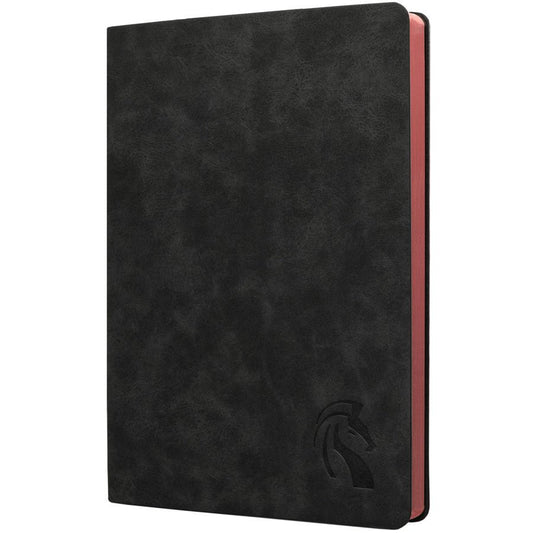
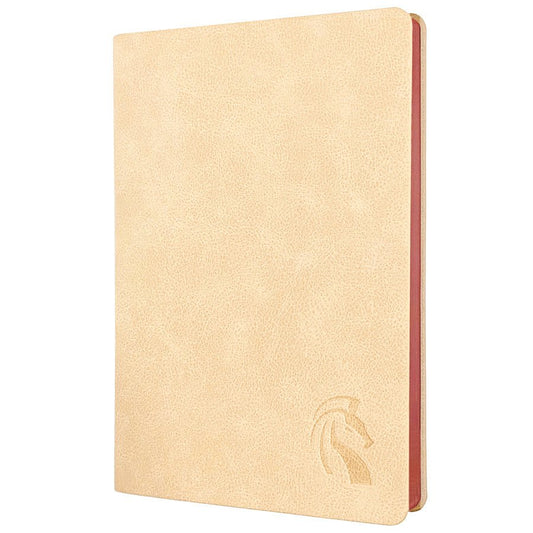
The LeStallion writing notebook encourages this ritual because it feels good to open. The cover is soft but sturdy. The binding lies flat, so you can write near the spine without fighting the curve. Those are the kinds of details that make you want to use it every day. And consistency is what builds a habit.
How I Use It in Practice
I keep my notebook on my desk, open to the current page. Every morning, I write down the three most important things I want to accomplish that day. Not a long list. Just three. That forces me to prioritize before the emails start flooding in. Then, throughout the day, I capture quick notes: a name I need to remember, a question I want to research, a decision I made in a meeting.
At the end of the day, I review my notes and transfer anything that needs follow-up into a simple task list on the next spread. The notebook becomes both a capture tool and a filter. I do not have to remember everything because it is written down. But I also do not have to sort through a mess because the structure keeps things clean.
I have tried digital tools for this workflow. Apps like Notion and Evernote are powerful, but they come with their own overhead. You have to organize folders, tag items, and maintain a taxonomy. Sometimes that is exactly what you need. But other times, you just want to write and move on. The notebook fits that gap. It is always on, always ready, and never needs a battery.
Trade-offs to Consider
No tool is perfect. If you need digital search, a paper notebook will not give you that. You cannot Ctrl+F to find a note from three months ago. You have to flip pages or use a simple index system. I solve this by using a small sticky note as a bookmark and writing key dates or topics on the inside cover. It is low-tech but effective.

Another trade-off is portability. The LeStallion writing notebook is not the smallest option out there. It is roughly A5 size, which is my sweet spot: big enough to write comfortably but small enough to fit in a tote bag. If you need something pocket-sized, this might not be the right fit. But for desk use or for carrying in a bag, it works well.
And then there is cost. A premium notebook costs more than a spiral-bound pad from the drugstore. But if you actually use it, the cost per day is negligible. I have been using mine for about three months, and I am slightly more than halfway through. At this rate, one notebook lasts me about five to six months. That is a small investment for the clarity it brings to my workday.
Why the Notebook Matters for Long-Term Thinking
One of the biggest challenges in knowledge work is connecting ideas across time. You have a thought in January that becomes relevant again in June. If you only rely on memory, you lose that connection. A notebook gives you a physical record you can revisit. I flip back through old pages and find ideas I had completely forgotten. Some of them are still useful. Others are outdated, but seeing them helps me understand how my thinking evolved.
The LeStallion writing notebook supports this kind of reflection because the pages are numbered. That is a small feature, but it makes a big difference when you want to reference something from weeks ago. I keep a simple table of contents on the first few pages, and I update it as I go. That turns the notebook into a searchable archive, even without a computer.
I also appreciate that the notebook does not try to be everything. It does not have a built-in calendar, habit tracker, or goal setting pages. That might seem like a missing feature, but I see it as a strength. It lets me use the notebook on my own terms. I can design my own system instead of fitting into someone else's. For people who like to customize their workflow, that is a big advantage.
Final Thoughts on Building a Writing Habit
If you are considering a switch to a better notebook, do not overthink it. The best tool is the one you will actually use. I have seen friends buy expensive journals and then never write in them because the pressure was too high. The LeStallion writing notebook avoids that trap by being both beautiful and forgiving. It invites you to write without demanding perfection.
Start with one page a day. Do not worry about filling every line. Just write something: a task, a thought, a question. Over time, that habit builds momentum. You will start to notice patterns in your thinking. You will capture ideas you would have lost. And you will have a record you can look back on with genuine interest.
That is the real value of a good notebook. It is not about the paper or the binding. It is about giving your thoughts a home where they can grow. The LeStallion writing notebook happens to be the best home I have found so far. It might work for you too.
❧